
Network marketing has changed significantly as businesses have moved from manual processes to digital platforms. Managing a growing distributor network today involves much more than maintaining contact lists.
Companies may need to track sales, manage genealogy structures, calculate commissions, process payouts, monitor performance, and communicate with distributors across multiple channels.
This is where MLM software has become increasingly useful. A centralized software platform can bring several network management activities together, helping businesses reduce repetitive administrative work and organize operations more efficiently.
However, software is not simply about automating commissions. Modern MLM platforms can support distributor management, reporting, mobile access, integrations, security, and other operational requirements.
What Is MLM Software?
MLM software is a technology platform designed to help multi level marketing and direct selling businesses manage their network and day to day operations.
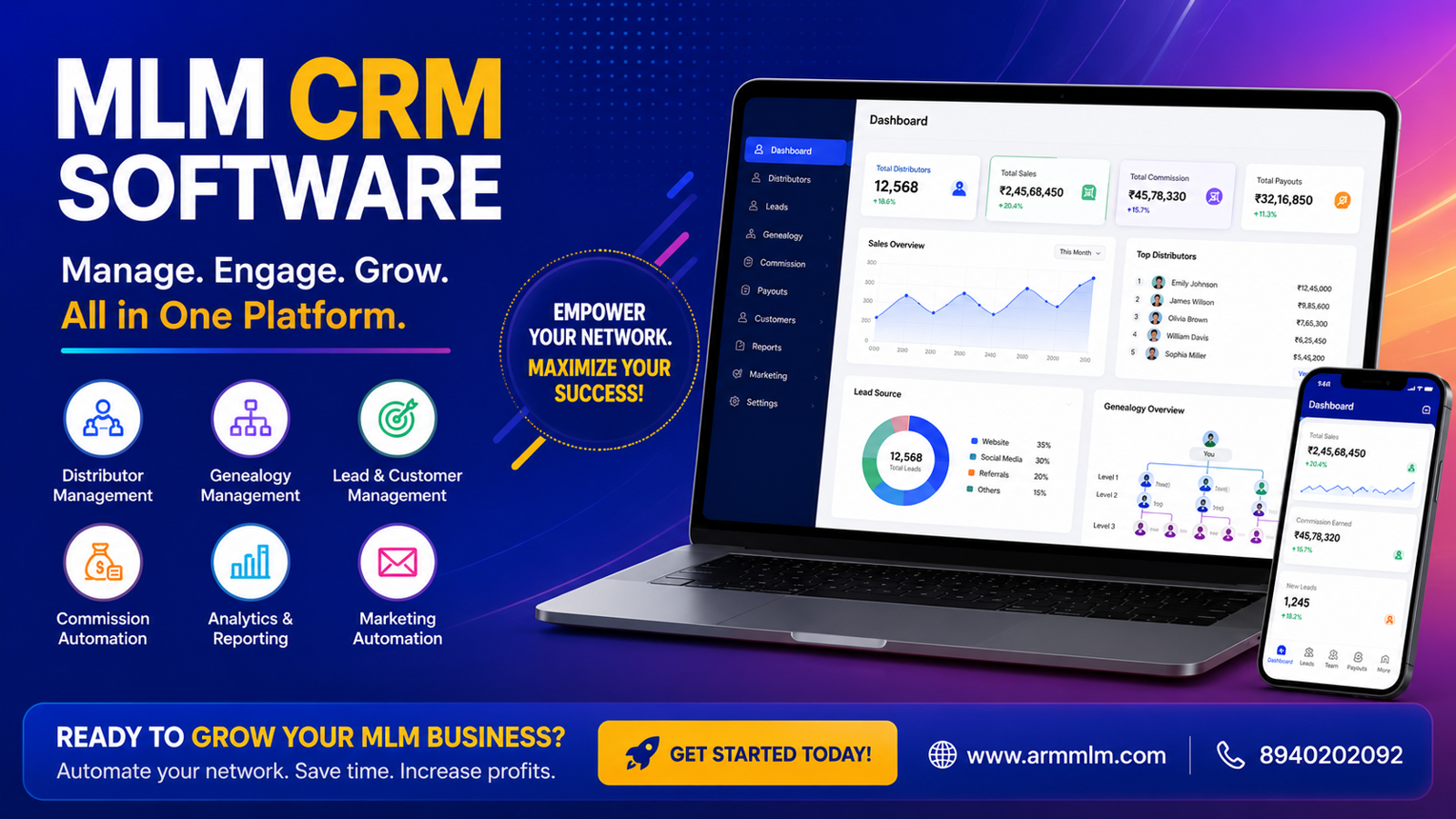
Depending on the platform, functionality may include distributor registration, genealogy management, sales tracking, commission calculations, rank management, e wallet management, payouts, reports, notifications, and administrative controls.
Businesses can use these systems to replace disconnected spreadsheets and manual processes with a centralized digital environment.
Understanding what MLM software is can help business owners determine which functions they actually need before evaluating different platforms.
Why Are Network Marketing Businesses Moving Toward Automation?
Manual management becomes increasingly difficult as a network expands.
Consider commission processing as an example. Administrators may need to collect sales information, check distributor eligibility, apply compensation rules, calculate commissions, and prepare payout records. Performing these tasks manually becomes more complicated when transaction volumes increase.
Automation can handle predefined calculations and workflows consistently.
This does not mean human oversight becomes unnecessary. Businesses still need to establish clear rules, review exceptions, monitor transactions, and ensure that their compensation structure operates as intended.
The main advantage is that software can reduce repetitive work while giving administrators greater visibility into business activity.
Managing Distributor Information in One Place
Distributor management is a fundamental part of network marketing operations.
A centralized platform can store information such as distributor profiles, sponsor relationships, registration details, sales activity, ranks, commissions, and account history.
Instead of maintaining separate spreadsheets for different activities, administrators can work from a single system.
This can also improve accessibility for distributors. Depending on the platform, members may be able to log in and view their sales, commissions, network information, and other relevant account details.
Managing Different Compensation Plans
Not every network marketing business uses the same compensation structure.
Some businesses use Binary plans, while others may use Unilevel, Matrix, Hybrid, or other models. Each structure can have different rules for placement, qualification, commissions, bonuses, and rank progression.
For example, a Binary structure generally involves two legs, while a Unilevel structure can support multiple levels beneath a distributor.
Software can help apply these rules systematically. Businesses considering a Binary structure can learn more about how a Binary MLM compensation plan works before deciding how their technology should be configured.
The important point is that software should match the compensation model rather than forcing a business to change its operational rules simply to fit a platform.
Automating Commission Calculations
Commission calculations are often among the most complex processes in network marketing.
Depending on the compensation plan, calculations may involve personal sales, group volume, levels, ranks, bonuses, matching commissions, or other qualification criteria.
MLM software can apply predefined rules to sales and distributor data and generate commission results according to the configured plan.
Automation can help reduce repetitive calculations and improve consistency. It can also make it easier for administrators to review commission records and identify discrepancies.
Before implementing a system, businesses should document their compensation rules clearly and test different scenarios, including successful qualifications, failed qualifications, refunds, cancellations, and other exceptions.
Making Payouts More Organized
Commission calculation is only one part of the payment process.
Once commissions are generated, businesses need to manage withdrawal requests, account balances, transaction records, approvals, and payments.
An MLM platform may provide an e wallet and payout management system to organize these activities.
A centralized transaction history can also provide greater visibility into how funds move through the system.
Where payment gateways or financial platforms are involved, integration requirements should be evaluated carefully before implementation.
Why Mobile Access Matters
Distributors increasingly expect to access business information from smartphones and tablets.
A mobile friendly MLM platform can allow users to view network activity, sales information, commissions, notifications, and other account details without relying entirely on a desktop computer.
Some businesses may only require a responsive web platform, while others may benefit from a dedicated application.
For organizations that need a dedicated mobile experience, MLM mobile app development can be considered as part of the broader technology strategy.
Mobile access is particularly useful when distributors operate across different locations and need information while travelling or meeting customers.
Connecting MLM Software With Other Systems
Modern network marketing businesses often depend on several digital systems.
An MLM platform may need to connect with:
Payment gateways
E commerce platforms
CRM systems
Accounting software
Communication tools
Marketing platforms
External APIs
Without integration, administrators may have to manually move information between systems, increasing the possibility of delays and errors.
API based connections can allow different applications to exchange information automatically. Businesses with multiple digital tools can therefore consider an API integrated MLM software approach when planning their technology infrastructure.
The exact integration requirements will depend on the systems already being used by the business.
Security Is a Core Requirement
MLM platforms can handle considerable amounts of business and distributor information.
This may include personal information, transaction records, sales data, commission details, account information, and other sensitive records.
Security should therefore be considered during software selection and implementation.
Businesses should examine areas such as:
Authentication
User permissions
Data encryption
Secure payment processing
Database protection
Backup procedures
Monitoring and logging
Software updates
Security requirements can also vary depending on the countries and markets in which the business operates.
Scalability and Network Growth
A software platform should not only work for today's network. Businesses should also consider what happens when the number of distributors and transactions increases.
As a network grows, the platform may need to handle more registrations, sales records, commission calculations, reports, and concurrent users.
Scalability therefore becomes an important factor when evaluating an MLM platform.
Businesses can ask providers about their infrastructure, database architecture, performance optimization, backup procedures, and expected user capacity.
Choosing a platform that can accommodate projected growth may help businesses avoid an unnecessary technology migration later.
The Role of AI in MLM Software
Artificial intelligence is becoming increasingly common in business applications, and network marketing platforms are beginning to explore AI driven capabilities as well.
Potential applications include:
Business data analysis
Automated reporting
Distributor insights
Customer support
Pattern detection
Recommendations
Performance monitoring
For example, analytical tools could identify changes in sales activity or unusual transaction patterns that may require administrator attention.
However, businesses should evaluate AI features based on their actual use case. An AI feature should have a clear purpose, appropriate data inputs, and sufficient human oversight, particularly when it is involved in important business decisions.
What Features Should Businesses Look For?
There is no single feature list that works for every network marketing company.
The right combination depends on the business model, distributor network, compensation plan, products, markets, and operational processes.
However, common areas to evaluate include:
Distributor Management
The platform should provide tools for registration, profiles, account management, and network relationships.
Genealogy Management
Administrators and distributors may need a visual representation of network relationships and placements.
Commission Management
The system should support the calculations and qualification rules required by the compensation plan.
Reporting
Reports can help administrators monitor sales, commissions, distributor activity, and other business information.
E Wallet
An integrated wallet can provide a centralized way to manage distributor balances and transactions.
Mobile Access
Responsive interfaces or dedicated applications can improve accessibility for distributors.
Integrations
API and third party integrations can connect MLM software with other business systems.
Businesses can review a detailed overview of MLM software features when creating their own evaluation checklist.
Ready Made or Custom MLM Software?
Businesses generally have two broad approaches when selecting MLM technology: ready made software and custom development.
Ready made platforms can be appropriate when the business has relatively standard requirements and wants to deploy a solution without developing every component from scratch.
Custom software may be more suitable when a company requires specialized compensation rules, unique workflows, custom dashboards, or complex integrations.
The decision should be based on actual requirements rather than assuming that one approach is always better.
Businesses considering customization can explore custom MLM software as one possible approach.
How Should a Business Evaluate MLM Software?
Choosing software should begin with business requirements rather than marketing claims.
A practical evaluation process can include the following steps:
1. Define the compensation plan
Document how commissions, bonuses, ranks, and qualifications work.
2. Identify operational requirements
List the processes that need to be managed or automated.
3. Determine integration needs
Identify payment gateways, e commerce platforms, CRM systems, and other applications that need to connect with the MLM platform.
4. Consider future growth
Estimate expected distributor and transaction growth rather than evaluating the system only for current requirements.
5. Review security
Ask how distributor and transaction data is protected.
6. Test the platform
A software demonstration can reveal how easily administrators and distributors can complete important tasks.
7. Understand the total cost
Consider licensing, customization, hosting, integrations, maintenance, and other potential expenses.
8. Evaluate technical support
Find out how software updates, bugs, technical issues, and future requirements are handled.
Why a Software Demo Can Be Useful
Feature lists can tell you what a platform claims to offer, but they do not always show how the software works in practice.
A live demo allows businesses to examine actual workflows.
During a demo, it can be useful to test:
Distributor registration
Sponsor assignment
Genealogy viewing
Sales entry
Commission calculations
Rank updates
E wallet transactions
Withdrawal requests
Reporting
Administrative controls
Businesses can also use an MLM software demo to understand whether a platform's interface and workflows are suitable for their team.
What Does the Future of MLM Software Look Like?
MLM software is likely to continue evolving alongside broader business technology.
Automation, mobile accessibility, APIs, analytics, cloud infrastructure, and artificial intelligence are expected to influence how network marketing businesses manage their operations.
The focus may gradually move from simply recording transactions toward providing more useful business insights.
For example, administrators may increasingly expect software to identify trends, monitor network performance, and surface information that can support better operational decisions.
At the same time, fundamentals such as accurate commission processing, reliable data management, security, and scalability will remain important.
Final Thoughts
MLM software is changing network marketing by bringing distributor management, genealogy, commissions, payouts, reporting, mobile access, and integrations into centralized digital systems.
The benefits, however, depend on selecting and configuring technology around the actual requirements of the business.
Rather than choosing software based solely on price or the number of advertised features, businesses should evaluate compensation plan compatibility, automation, scalability, security, integrations, customization, mobile accessibility, and technical support.
A well planned software strategy can provide a more organized foundation for managing network marketing operations while leaving room for the business to adapt as its network and technology requirements evolve.




Write a comment ...