
Choosing the right MLM commission plan can have a major impact on how a network marketing business manages distributors, rewards performance, and supports long-term growth.
The compensation plan defines how distributors earn commissions from personal sales, team performance, ranks, bonuses, or other qualifying activities.
In 2026, businesses are looking for compensation structures that are easier to manage, scalable, transparent, and compatible with modern MLM software.
While traditional plans continue to remain popular, businesses are also exploring flexible and hybrid models that can be adapted to different products, markets, and sales strategies.
There is no single compensation plan that works for every MLM business. The right choice depends on the company's products, sales model, distributor strategy, commission budget, and growth objectives.
Here are the top 5 MLM commission plans to watch in 2026.
What Is an MLM Commission Plan?
An MLM commission plan is the structure a network marketing company uses to determine how distributors are rewarded for sales and business performance.
Depending on the model, commissions may be calculated based on personal sales, direct referrals, team sales, sales volume, organizational levels, rank achievements, or leadership performance.
A well-designed compensation plan should be easy for distributors to understand and financially sustainable for the company. It should also encourage genuine product or service sales rather than focusing primarily on recruitment.
1. Binary MLM Commission Plan
The Binary MLM plan continues to be one of the most recognized compensation structures in network marketing. It generally organizes a distributor's team into two primary legs, often referred to as the left and right legs.
The commission calculation can be based on the sales volume generated by these legs. For example, if both legs generate qualifying volume, the company may calculate commissions according to its predefined rules.
One of the reasons the Binary plan remains popular is its focus on team development. Distributors can concentrate on building and supporting two major organizational legs rather than managing an unlimited number of direct positions.
Modern MLM software can make Binary plan management easier by providing genealogy trees, automated placement, volume tracking, commission calculations, and distributor dashboards.
Best suited for: Businesses that want a team-focused structure with two primary organizational legs.
2. Unilevel MLM Commission Plan
The Unilevel MLM plan is known for its relatively straightforward structure. A distributor can typically sponsor multiple members directly, while those members can build their own teams underneath them.
The organization is divided into levels, and the company determines how commissions are paid across those levels.
For example, a business may define different commission percentages for Level 1, Level 2, Level 3, and so on. The exact number of levels and commission rates depends on the company's compensation strategy.
The simplicity of the Unilevel structure makes it easier for many distributors to understand. It can also be easier to explain during distributor onboarding.
MLM software can automate level-based commission calculations and provide a visual genealogy of the organization.
Best suited for: Businesses looking for a straightforward, level-based compensation structure.
3. Matrix MLM Commission Plan
The Matrix MLM plan uses a predefined width and depth to create a structured network. Common examples include 3×3, 4×4, and 5×5 matrices.
The first number generally represents the width of the structure, while the second represents its depth.
For example, a 3×3 Matrix can provide three positions across the first level and a defined number of positions through subsequent levels.
A Matrix structure can give businesses greater control over network organization and distributor placement. Depending on the business rules, automated placement can also be used to fill available positions.
However, businesses should ensure that distributors clearly understand how placement, commissions, and qualification requirements work.
Best suited for: Businesses that prefer a predefined and structured network organization.
4. Hybrid MLM Commission Plan
The Hybrid MLM plan combines elements of two or more compensation structures. For example, a business may combine Binary and Unilevel features to create a customized compensation model.
This flexibility can be valuable for companies with specific business requirements that cannot be fully addressed by a standard compensation plan.
A Hybrid plan may include different commission mechanisms for personal sales, team performance, levels, ranks, or leadership incentives.
The main advantage is flexibility, but this can also make the plan more complicated. Businesses need to clearly communicate how commissions are calculated so distributors understand the earning structure.
Advanced MLM software can help manage customized rules, genealogy structures, bonuses, and commission calculations within a Hybrid plan.
Best suited for: Businesses that need a customized compensation structure combining multiple MLM models.
5. Stair-Step MLM Commission Plan
The Stair-Step MLM plan focuses on distributor performance and rank advancement. Distributors generally move through different ranks after achieving specific sales or team performance requirements.
As distributors move to higher ranks, they may become eligible for different commission rates, bonuses, or leadership incentives based on the company's rules.
This structure can encourage distributors to focus on improving sales performance and developing their teams.
For businesses using this model, rank tracking is particularly important. MLM software can automatically monitor qualifying activity and show distributors how close they are to reaching the next rank.
Best suited for: Businesses that want to emphasize performance, leadership development, and rank-based incentives.
Top 5 MLM Commission Plans Compared

Which MLM Commission Plan Is Best for Your Business?
There is no universal answer to this question. The right MLM compensation plan should match the company's products, customers, pricing, sales strategy, and distributor structure.
A business should consider whether the plan is easy to explain, financially sustainable, scalable, and capable of encouraging genuine product sales.
For example, a business that wants a simple structure may consider Unilevel, while a company focused on two-leg team development may prefer Binary. Businesses requiring greater customization may consider Hybrid models.
The compensation plan should also be compatible with the company's MLM software so that commissions, genealogy, ranks, bonuses, and payouts can be managed accurately.
How MLM Software Supports Commission Management
As an MLM network grows, managing commissions manually becomes increasingly difficult. A distributor network can involve thousands of sales transactions, multiple qualification rules, different ranks, and numerous commission calculations.
MLM software can automate many of these processes.
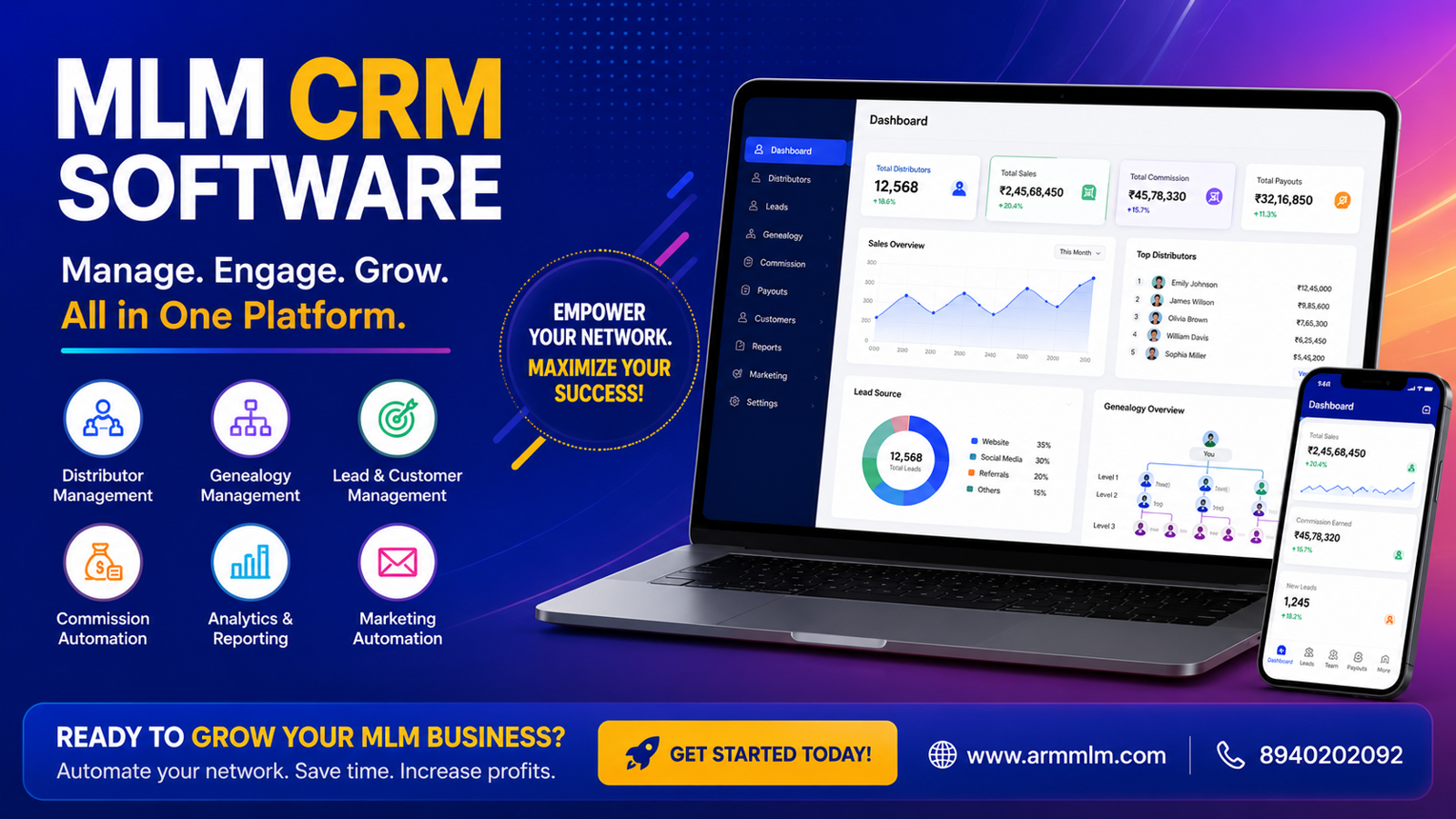
Depending on the platform, businesses can manage distributor registration, genealogy, sales volume, commission calculations, rank progression, bonuses, e-wallets, payouts, and reporting through a centralized system.
This can reduce repetitive administrative work and provide distributors with better visibility into their earnings and team performance.
AI and the Future of MLM Commission Management
AI is also becoming an important technology trend in MLM software.
While commission rules should remain transparent and based on clearly defined business logic, AI can help businesses analyze the data generated by their compensation systems.
For example, AI-powered MLM software can support distributor performance analysis, sales trend identification, network analytics, automated reporting, and business insights.
This can help businesses move beyond simply calculating commissions and start using network data to understand performance and identify areas that may require attention.
Final Thoughts
The top 5 MLM commission plans to watch in 2026 are Binary, Unilevel, Matrix, Hybrid, and Stair-Step. Each model offers a different approach to organizing distributors and rewarding performance.
Binary focuses on two-leg team structures, Unilevel provides a straightforward level-based model, Matrix offers predefined network structures, Hybrid provides flexibility, and Stair-Step emphasizes rank and performance.
The best choice is not necessarily the most popular plan. It is the one that fits your products, customers, business economics, distributor strategy, and long-term goals.
Once the compensation structure is established, the right MLM software can help automate its management, simplify commission processing, track distributor performance, and provide a better experience for administrators and distributors.
In 2026, combining a clear compensation structure with reliable automation and intelligent business tools can help network marketing companies build more organized and scalable operations.






Write a comment ...